1975_Sackson_101_March 22.jpg: Page #1
Original title: 1975_Sackson_101_March 22.jpg
Transcription
MARCH 1975 - SATURDAY 22
81ST DAY - 284 DAYS TO COME
Letter from Don Turnbull. Mentions ALBION, KINGMAKER, EPIMONIDAS, MACHIEVAL, KGB, BRIDGETTE, MYWORD!, LOGICA, CROWN CHESS, MOVIEMAKER, ACQUIRE, WOLFPACK [S.P.I.], PANZER LEADER, NEW TOWN, and his new magazine PHOENIX.
Played a little SNIGGLE with BB and Dale. They liked it. Played all of the SLY 6 games with Phil Laurence, with Eliott for a short time. Late when we started and very late when we ended, so couldn't get too good an impression.
Gave Dale a copy of PUSHOVER to use as a house gift.
(cont. from 3/21) [3/21]
this should be the feature. Told Wald this. Also that I didn't like the "contracts." He likes them for bargaining. I suggested the more than one skeleton might accomplish this.
Incidentally, once a contract is proved, each share pays
$100 per pip when landed on. On the 7 space racket
this brings money in too quickly. In bidding for shares
the player announcing the racket must accept the highest
bid - such as 8 shares at $300 each (1 share at $400 would
be higher) but may not prove the racket on his next turn
if he has too few cards shares himself. If a player
throws a 7 he can buy a face up card from another
player for $700, and can also players can bargain for a
face up card at anytime. A player can never take a card
directly from his own face up cards.
While we were playing, Claude, Dave, and Wald's girl friend played SUCCESS. It was, Claude told me, pretty much the same as when we played - except that when a player landed on another player he "bumped" him one space forward. Certain spaces were marked and a player bumped into one of there had to make a payment to the bumper. (Dave suggested that to simplify things a player doesn't pay before taking his gamble. Instead, after throwing dice he either pays or collects.)
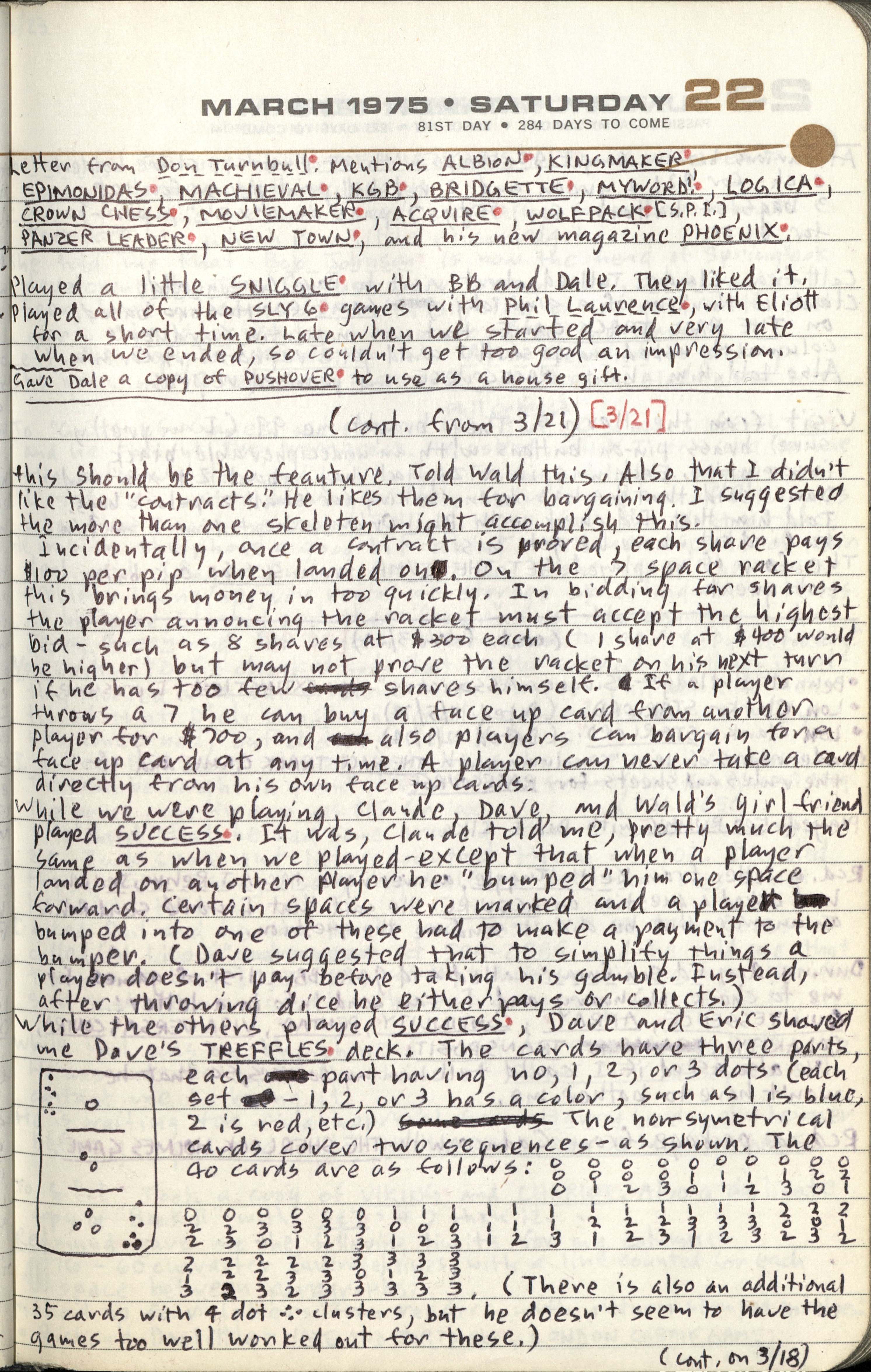
While others played SUCCESS, Dave and Eric showed
me Dave's TREFFLES deck. The cards have three parts,
[drawing of card] each one part having no, 1, 2, or 3 dots (each
set of - 1, 2, or 3 has a color, such as 1 is blue,
2 is red, etc.) some cards The non-symetrical
cards cover two sequences - as shown. The
40 cards are as follows:
[drawings of 40 sequences]
(There is also an additional
35 cards with 4 dot clusters, but he doesn't seem to have the
games too well worked out for these.)
(cont. on 3/18)