1973_Sackson_031_January 11.jpg: Page #1
Original title: 1973_Sackson_031_January 11.jpg
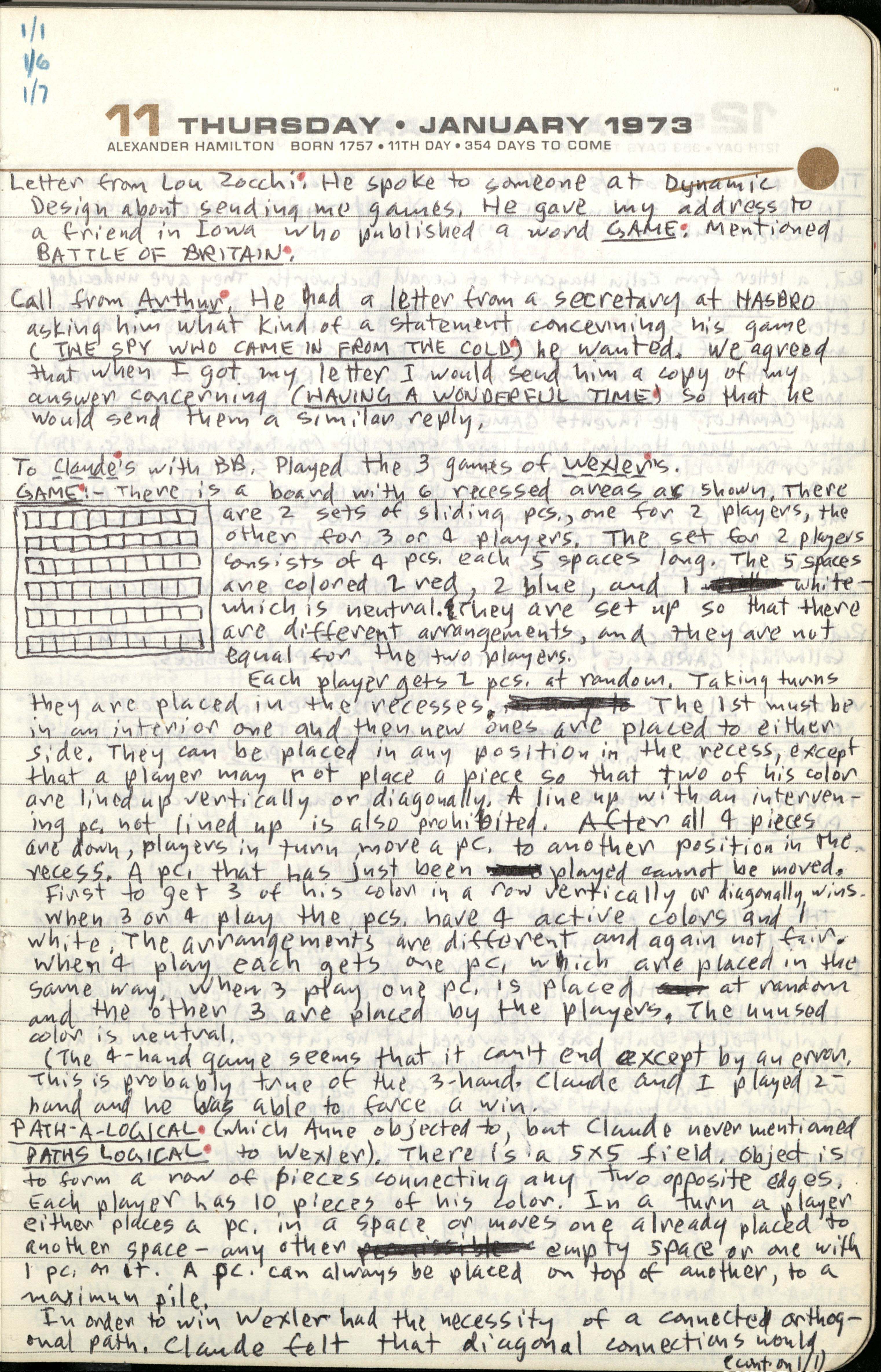
Transcription
1/1
1/6
1/7
11 Thursday - January 1973
Alexander Hamilton Born 1757 - 11th Day - 354 Days to Come
Letter from Lou Zocchi. He spoke to someone at Dynamic Design about sending me games. He gave my address to a friend in Iowa who published a word GAME. Mentioned BATTLE OF BRITAIN.
Call from Arthur. He had a letter from secretary at HASBRO asking him what kind of a statement concerning his game (THE SPY WHO CAME IN FROM THE COLD) he wanted. We agreed that when I got my letter I would send him a copy of my answer concerning (HAVING A WONDERFUL TIME) so that he would send them a similar reply.
To Claude's with BB. Played the 3 games of Wexler's.
GAME:- There is a board with 6 recessed areas as shown.
[drawing of a board with 6 rows divided into 10 spaces each]
There
are 2 sets of sliding pcs. [pieces], one for 2 players, the
other for 3 or 4 players. The set for 2 players
consists of 4 pcs. [pieces] each 5 spaces long. The 5 spaces
are colored 2 red, 2 blue, and 1 [illegible strikeout] white -
which is neutral. They are set up so that there
are different arrangements, and they are not
equal for the two players.
Each player gets 2 pcs. [pieces] at random. Taking turns
they are placed in the recesses. [illegible strikeout] The 1st must be
in an interior one and then new ones are placed to either
side. They can be placed in any position in the recess, except
that a player may not place a piece so that two of his color
are lined up vertically or diagonally. A line up with an intervening
pc. [pieces] not lined up is also prohibited. After all 4 pieces
are down, players in turn move a pc. [piece] to another position in the
recess. A pc. [piece] that has just been [illegible strikeout] played cannot be moved.
First to get 3 of his color in a row vertically or diagonally wins.
When 3 or 4 play the pcs. [pieces] have 4 active colors and 1
white. The arrangements are different and again not fair.
When 4 play each gets one pc. [piece] which are placed in the
same way. When 3 play one pc. [piece] is placed and at random
and the other 3 are placed by the players. The unused
color is neutral.
(The 4-hand game seems that it can't end except by an error.
This is probably true of the 3-hand. Claude and I played 2-
hand he has was able to force a win.
PATH-A-LOGICAL (which Anne objected to, but Claude never mentioned
PATHS LOGICAL to Wexler). There is a 5x5 field. Object is
to form a row of pieces connecting any two opposite edges.
Each player has 10 pieces of his color. In a turn a player
either places a pc. [piece] in a space or moves one already placed to
another space - any other permissible empty space or one with
1 pc. [piece] on it. A pc. [piece] can always be placed on top of another, to a
maximum pile.
In order to win Wexler had the necessity of a connected orthogonal
path. Claude felt that diagonal connections would
(cont. on 1/1)